
‘Happy Bear’ Signs
By Debra Jane Seltzer
All photos by the author
The Bear Manufacturing Company was established in Rock Island, Illinois, in 1917 as an auto luggage rack producer. The company used the slogan “Let Bear Lug Your Luggage.” Although it is not known where the Bear name came from, it is thought that the animal was chosen to convey strength. A more realistic bear was used in early advertising.
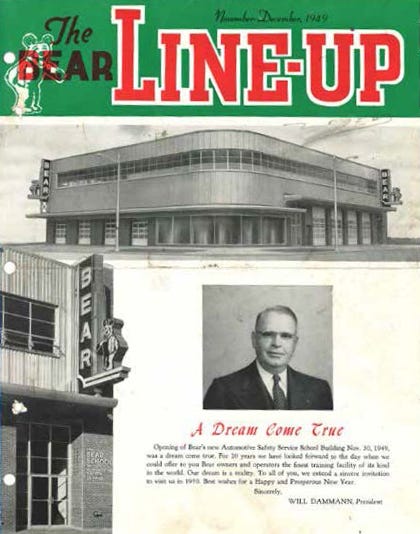
This 1949 issue of The Bear Line-Up featured the company’s beloved signage on its new school.
By the early 1920s, Bear began producing wheel alignment tools. During this time, the company developed the yellow “Happy Bear” character which was used in print and signs across the United States. The bear symbol indicated that those auto shops had been trained by Bear and used Bear wheel alignment and diagnostic tools. By the late 1920s, the company was training mechanics from all over the country at its Rock Island headquarters.
The training school was a popular destination for servicemen returning from World War II who were interested in learning a trade and starting their own businesses. In response to the demand, a Streamline Moderne building was constructed in 1949 specifically for the Bear Automotive Safety Service School. At the time, the company was training around 1,000 mechanics annually. While the two neon bear signs are gone from the facade, the building still stands.
The Happy Bear is also referred to as the “Laughing Bear” or the “Dancing Bear.” The Grateful Dead rock band used a slightly modified, dancing version of the bear logo in the early 1970s. While the character was used without permission, Bear Manufacturing never pursued the band legally. Applied Power Industries bought Bear Manufacturing in 1970. The training school closed then or shortly after that. Afterwards, the Bear Automotive Service Equipment Company was sold several times until Bear products disappeared when they were rebranded in 2009 by Cartek. Despite that, many auto shops still display Bear signs whether they continue to use Bear equipment or not. Once ubiquitous, there are now only about three dozen of these signs on display in 11 states, with most of them in Southern California. Many shop owners will proudly show you other Bear signs inside their bays or offices.
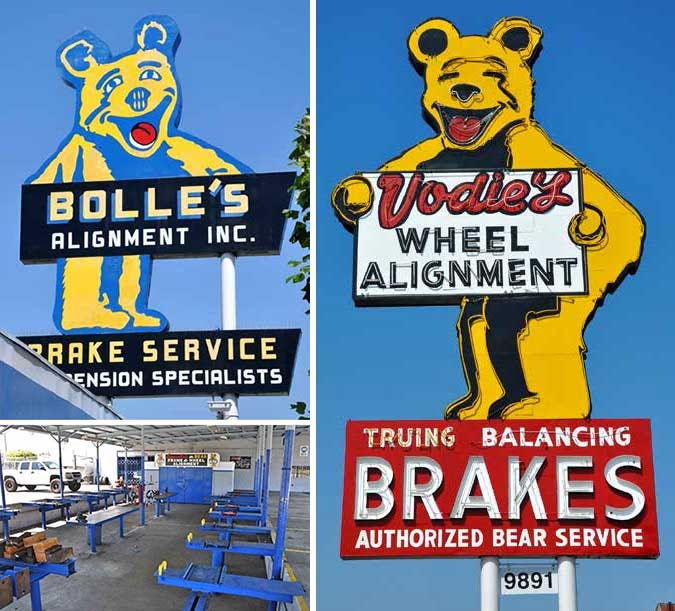
LEFT: Sign and racks at Bolles in Lynwood, Calif.
RIGHT: Vodie’s in Garden Grove, Calif.
After attending classes at Bear’s school in Illinois, Virgel Bolles opened Virgel’s Frame and Wheel Alignment in Torrance, California, in 1944. In 1948, Virgel moved to a larger shop and installed a Bear sign. That sign is still there, but the business is now known as Torrance Auto Repair. In 1947, Virgel’s younger brother, Wallace, opened Bolles’ Alignment Service in Lynwood, California. The shop’s sign was built then. It originally had neon and the bear’s animated mouth opened and closed. The sign panels are about 20 feet tall, and they are supported on two poles. When the sign was repainted around 2012, the owner made sure that the graphic matched vintage photos. Both of the bear’s paws are hidden behind the sign which he holds. This was typical of early Bear signs and advertising images, which usually read “Line Up with Bear.” When the Bolles’ sign was repainted, the misplaced apostrophe of “Bolle’s” was retained. The lower panel originally read “Brake Service, Tire Truing – Balancing” but it has read “Brake Service, Suspension Specialists” for decades. From the remaining paint, it is believed that the blue, yellow, and black paint scheme is original. According to David Bolles, Wallace’s son and the current owner, replacing the neon would have been far too expensive.
Bolles’ Alignment still has the original Bear racks from 1947. Like other Bear shops built in the 1940s and 1950s, these racks extend over a sunken pit. This enables mechanics to have quick and easy access to vehicle undercarriages. None of the owners that I spoke with that still have these pits knew of insurance company concerns about the dangers. They had no knowledge of accidents or lawsuits from people falling into the pits. By the late 1940s, Virgel Bolles had begun offering his own safety training classes for aspiring alignment shop owners.
Vodie Clemmons served in World War II with Virgel Bolles. He also trained at the Bear school in Illinois before opening his Vodie’s Wheel Alignment shops around 1946. Vodie had two shops in Orange County: one in Garden Grove and another in Santa Ana. A few Bear alignment shops in Southern California may have been owned by Vodie’s relatives. There are two identical signs in design and size, under many layers of paint, at other businesses in Gardena and Los Angeles. There are about eight similar but smaller signs in SoCal. Presumably, all or most of these had neon originally. They were apparently all built locally, and some were, most likely, produced by the same unknown sign shop.
The Vodie’s Wheel Alignment shop in Santa Ana became Guero’s Auto Repair in 2011. In 2014, the building was bulldozed while the sign was removed and donated to the Museum of Neon Art. That sign is currently at MONA’s storage facility in Pomona. It will eventually be restored and displayed at the museum in Glendale.
When the Vodie’s location in Garden Grove opened, it featured 10 roll-up car racks set over a sunken pit. The sign was installed then. The shop is now owned and operated by Vodie’s grandson, Hank Clemmons. Hank had the sign repainted in 2014 for about $7,000. The original wording was kept even though truing, the practice of shaving tires and adding new grooves, is not done anymore. The neon tubing, which has not been lit since around the 1970s, was masked during the painting and left intact. The bear was originally outlined with yellow neon while the mouth and text were red. As with the Lynwood sign, the bear’s neon mouth opened and closed. Some say that the bear’s paw closest to traffic flashed on and off as if he was waving but that is probably a myth.
Marvin Stanka, an employee of Virgel Bolles, struck out on his own in 1955 and opened Corona Brake & Wheel in Corona, California. A vintage photo from the 1950s shows mechanics dressed in white uniforms. The sign was probably installed when the shop opened. In 2015, it was repainted and restored for about $8,000. It is the only Bear sign at an operating shop with functioning neon. The business is now known as Bear Alignment & Brake. The workers now wear polo shirts with Happy Bear logos.
Glendora, Calif.
The sign at Bear Frame & Wheel in Glendora, California, is a simple plastic sign, most likely original, with orange Happy Bears. What makes this Bear business special is its unique spaceship-like building from 1962. The round canopy is supported by steel cables attached to a pole on the roof. The original Bear racks radiate around the sunken pit and central work space. Steel steps and a bridge lead to the upstairs office with vintage wood paneling and framed vintage photos of the shop. The owner of this Bear shop had another one in Duarte, California, but it was an ordinary box-shaped building. Outside of California, there are a variety of metal, plastic, and painted Happy Bear signs. The Moe Allen Auto Body Shop opened in Phoenix, Arizona, in 1955. The pole sign and painted bears which flank the service bay have been there since then. The pole sign and “Moe Allen” letters on the building had neon originally. The Autocraft Body Shop in Springfield, Illinois, opened in 1948. This one-of-a-kind sign was created around the mid-1950s. It was built from two porcelain panel wall signs produced by Bear that were previously displayed inside the shop. The panels were painted, and a steel “can” was built to go between them. The neon that was added then has not been lit since about the mid-1990s. In recent years, similar vintage signs have been spruced up with neon and reproduction signs with neon have been built for collectors. I don’t believe Bear Manufacturing ever produced neon signs.
Springfield, Ill., Bedford, Pa., Alpha, Ill., and Corona, Calif. by day and night.
[vc_gallery type=”image_grid” images=”2652,2645,2646,2650,2649″ img_size=”full” column_number=”5″ grayscale=”no” images_space=”gallery_with_space”]
Barton’s Body Shop in Alpha, Illinois, opened in 1950. This sign is from 1965 when Barton’s made an addition to the building. At that time, the shop added Bear racks and began offering Bear certified service.
The plastic, vacuum-formed sign at Barnes Garage in Bedford, Pennsylvania, is from the 1960s. These signs must have been mass-produced, presumably by Bear, but this is the only one now left on public display.
Visit www.roadarch.com/signs/bear.html for more about Happy Bear signs.
This article originally appeared in the SCA Journal, Fall 2017, Vol. 35, No. 2. The SCA Journal is a semi-annual publication and a member benefit of the Society for Commercial Archeology.