
Magnetic Hill
Where Cars Coast Uphill Without Power
By Peter Glaser
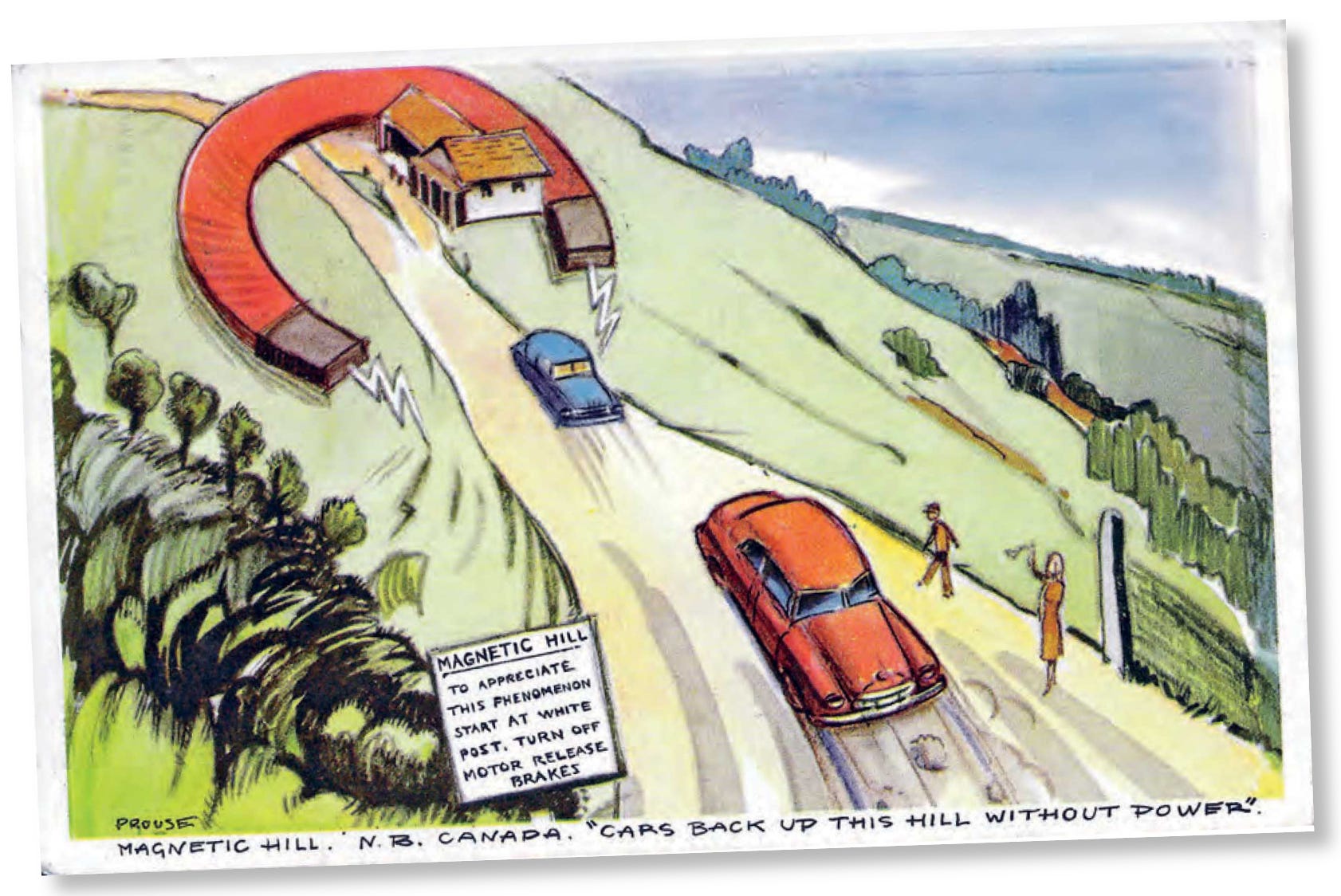
Adventures in an automobile are a lot of fun: drive-in restaurants and theaters, streets of neon, and drive-through trees come to mind. And then there are magnetic or gravity hills—natural ‘road’ wonders – the most famous of which is in Moncton, New Brunswick (the geographic center of the Maritime Provinces).
In 1933, a correspondent for the Saint John, New Brunswick Telegraph-Journal wrote:
There is a hill near Moncton, up which they say water will flow. If you stop your car at the foot of the hill, shut off your engine, put the gears in neutral, and take off the brakes—it will back up the hill!
In the horse and wagon days, locals used to talk about that ‘funny place’ on a backroad heading out of Moncton where horses tended to labor going down a hill and then tire as they continued up what appeared to be only a gradual incline. With the automobile’s arrival, it was more of the same: drivers were puzzled why they had to shift into low gear when traveling ‘down’ this hill.
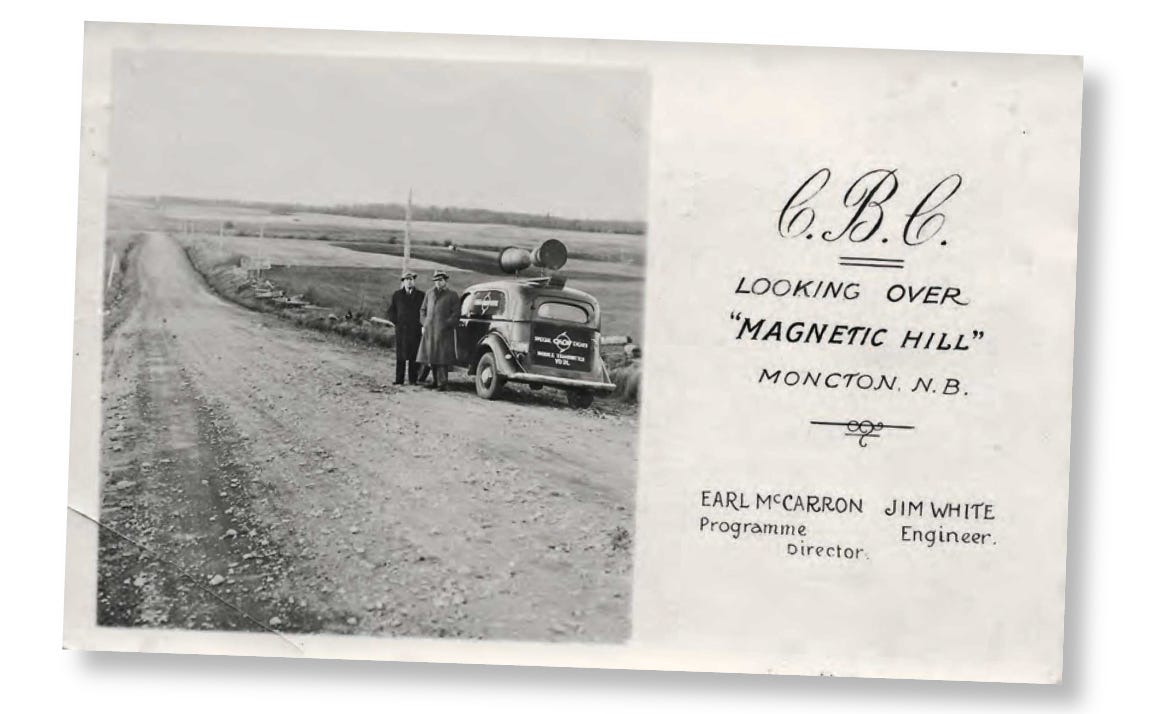
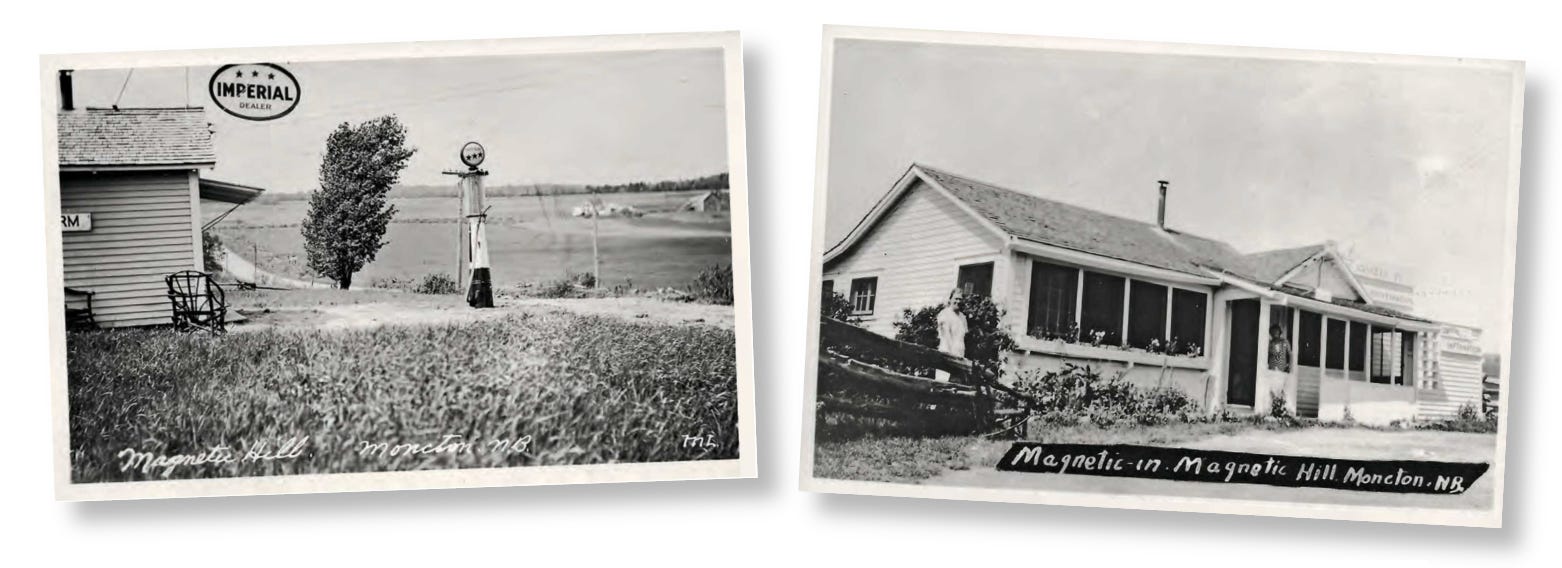
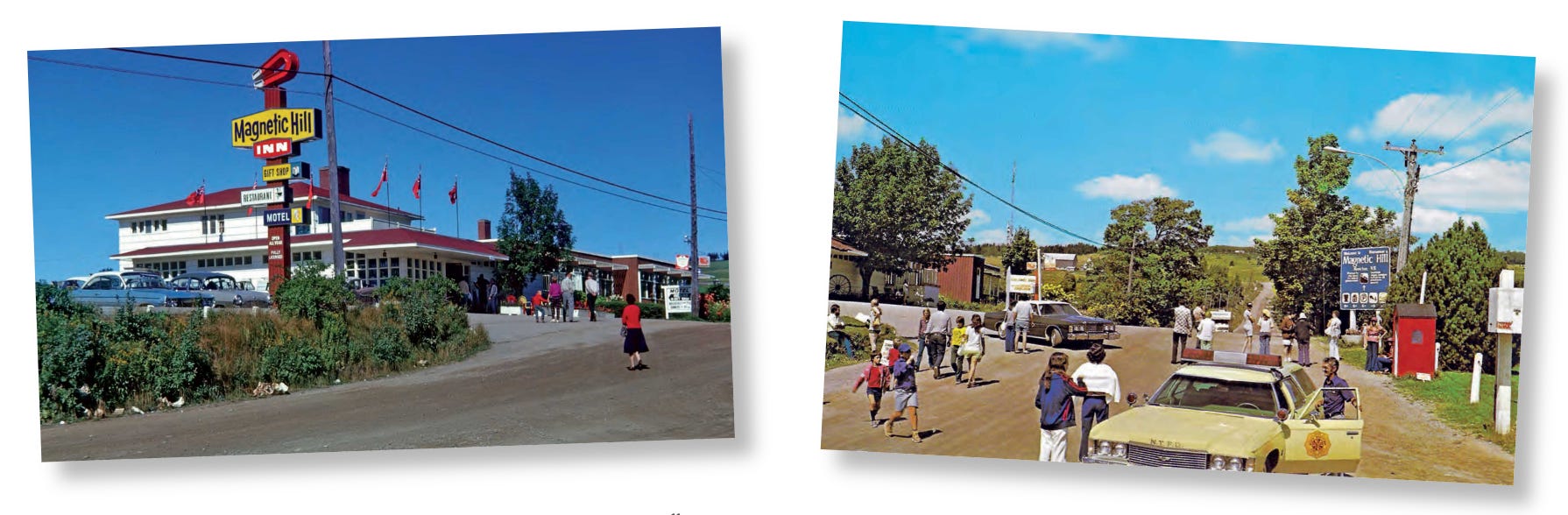
The 1933 article in the Telegraph-Journal brought attention to ‘the hill’ and no doubt gave rise to the area’s first roadside entrepreneur. In June of that year, Muriel Lutes opened a small wayside stand selling ice cream, refreshments, and souvenirs at ‘the top’ of what she had named Magnetic Hill. In short order, the business expanded to include a filling station, gift shop, restaurant, and small inn. By 1956, an enlarged two-story gift shop—the largest in eastern Canada—was in operation, and in 1960, a modern motel replaced the old inn.
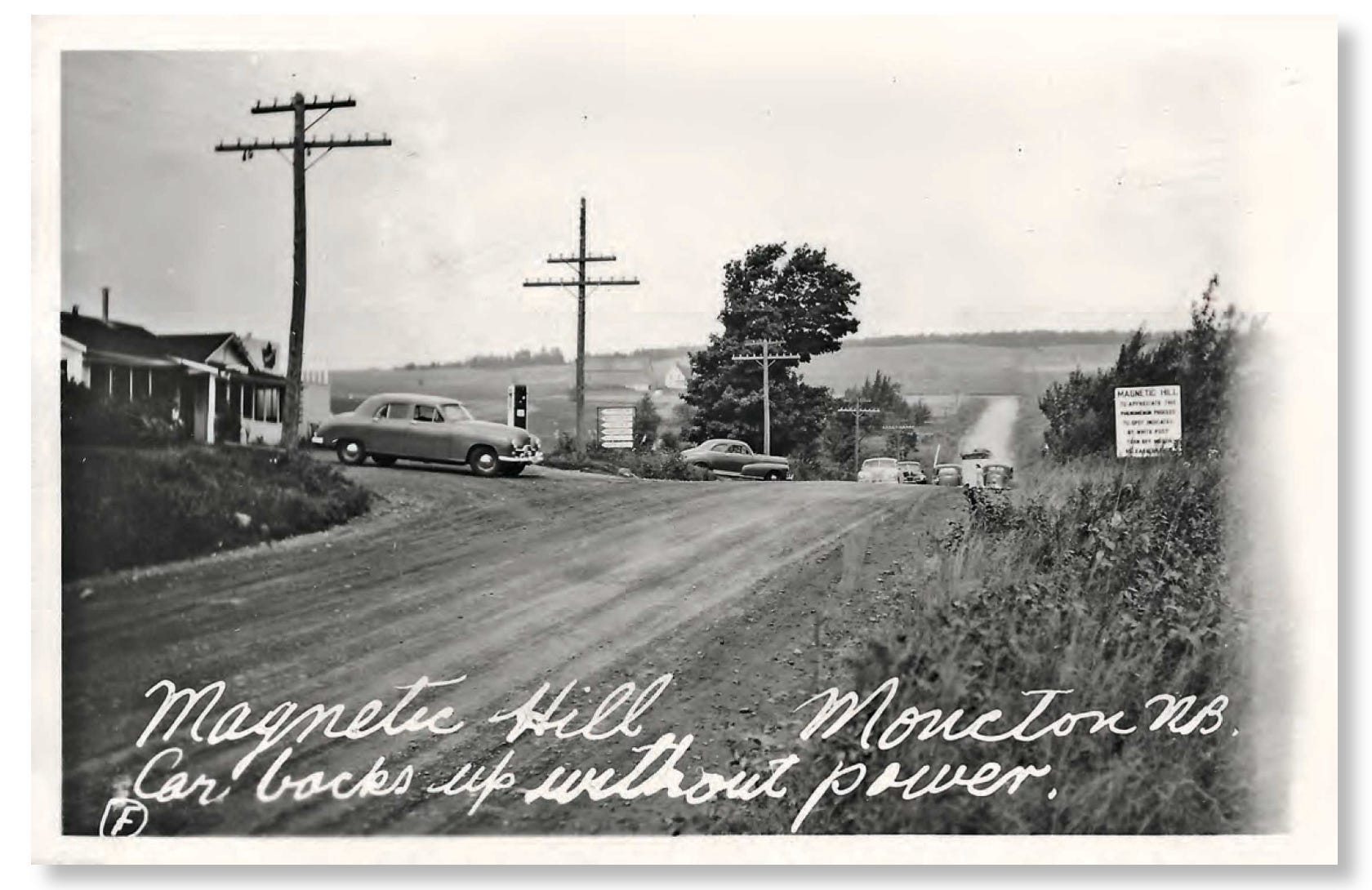
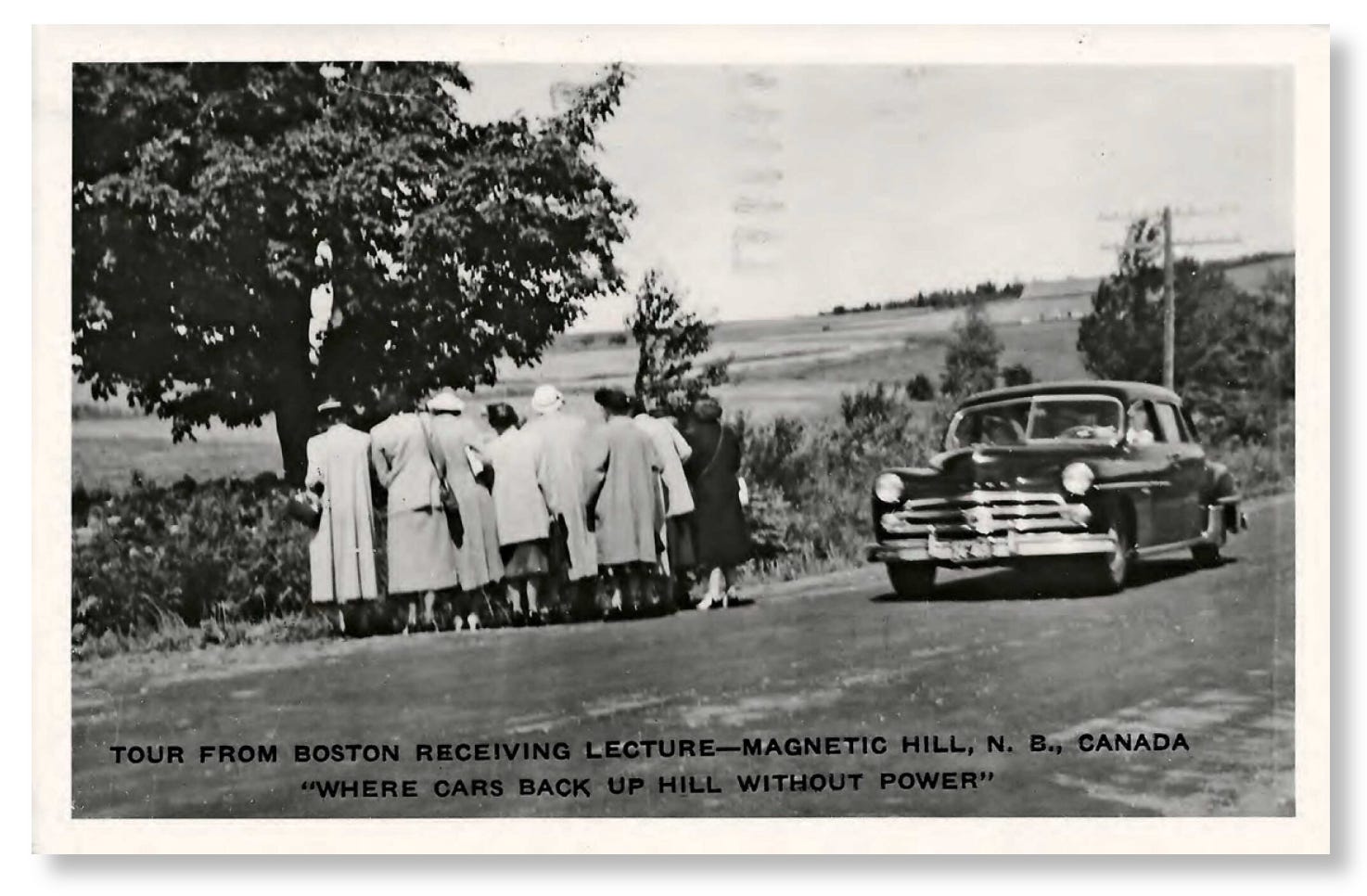
The “magnet” was growing more and more powerful, drawing people worldwide to ‘try the hill’ and marvel over its strange properties. Magnetic Hill evidently bemused engineers and healed the sick – but at all times entertained. In the 1950s, a reporter for the New York Sun described the experience:
The visitor … drives out to the top of the hill, stops his car, and looks down the straight road ahead. Perhaps a scant quarter of a mile away is a big white sign on one side of the road and a white pole on the other. It is, your eyes tell you, unquestionably the bottom of a very definite grade. It goes down, down at least ten to twenty feet in that four hundred odd yards—and from that point, just as obviously, climbs again.
So, you climb in your car. The road is smooth gravel with a hard base, offering little resistance to tires. You release the brake, but you don’t coast. Needs a bit of a start, you decide, and shift into low only to find that it takes a bit of power to drive down that hill to the white sign and post. At the foot of the hill, you get out to look back. Yes, sir. That is an upgrade. But you obey the sign on the white board—stop your motor, put the gear in neutral and release all brakes. The car moves—backward! Upgrade! It continues to move. You coast backward uphill to your starting point, where the ‘magnetism’ is pulling you right along at about ten or fifteen miles an hour.
There is, of course, nothing magnetic about the hill—it is simply a very impressive optical illusion. The same reporter added:
No one has completely solved the puzzle. It is probably due to several things—the lay of the surrounding land, the contour of the road margins, the angle of the grade on the far side, which rises sharply from the apparent ‘bottom’ of the ‘magnetic’ portion of the hill, and perhaps other less obvious factors.
There have been plenty of interesting reactions to the phenomenon over the years. For example, in July 1938, an American tourist related on a postcard the experience of walking the hill after driving it: “I felt a drawn sensation walking down. Walking back, we could move more easily just as if a tension had been loosened.”
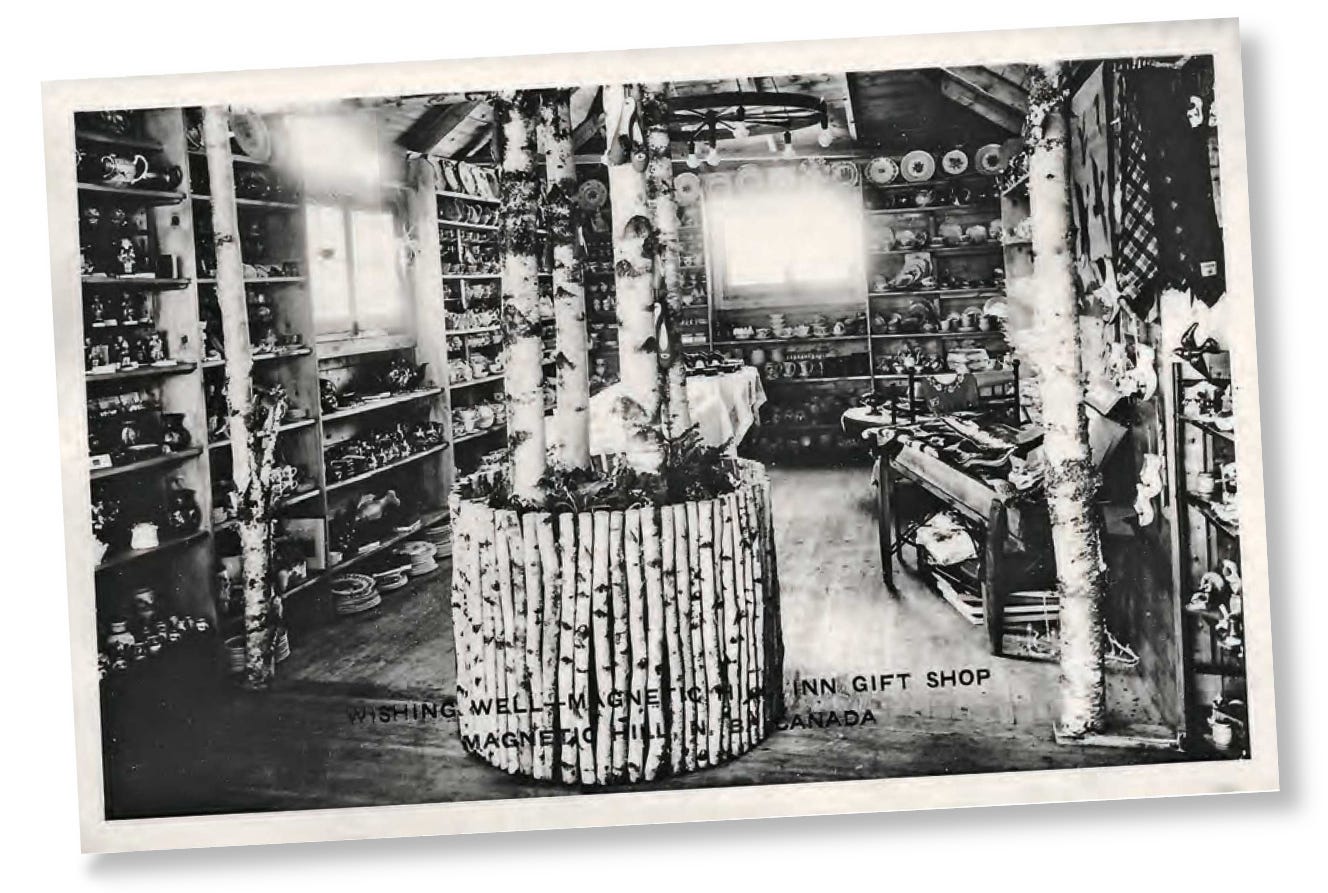
In the 1950s, an elderly gentleman, obviously of means, had taken one trip in his limousine, looked back ‘down’ the hill, turned to his chauffeur, and said, “Henry, let’s get out of here, the devils in it!” Perhaps most amusingly, another attendee, apparently a man of science, after trying the hill, got out of his car, shook his head, and said, “I haven’t had a drink today, but this calls for a special prescription,” upon which he opened his kit and passed the bottle.
In the 1950s, Magnetic Hill was Canada’s third most popular tourist destination—after Niagara Falls and Banff National Park. The province, capitalizing on the volume of visitors, established a zoo adjacent to the attraction in 1953.
In 1974, the business was sold to Stan Steeves, a Moncton businessman who owned an adjacent golf course (where those who “hook, sky, slice, smother, or otherwise scuff a shot” could conveniently blame that nearby mysterious hill for their poor game). Since then, Magnetic Hill has become a tourist mecca. The accumulation of attractions includes a waterpark, amusement park, four miniature golf courses, and a game zone—in short, the real magnetism of the place.
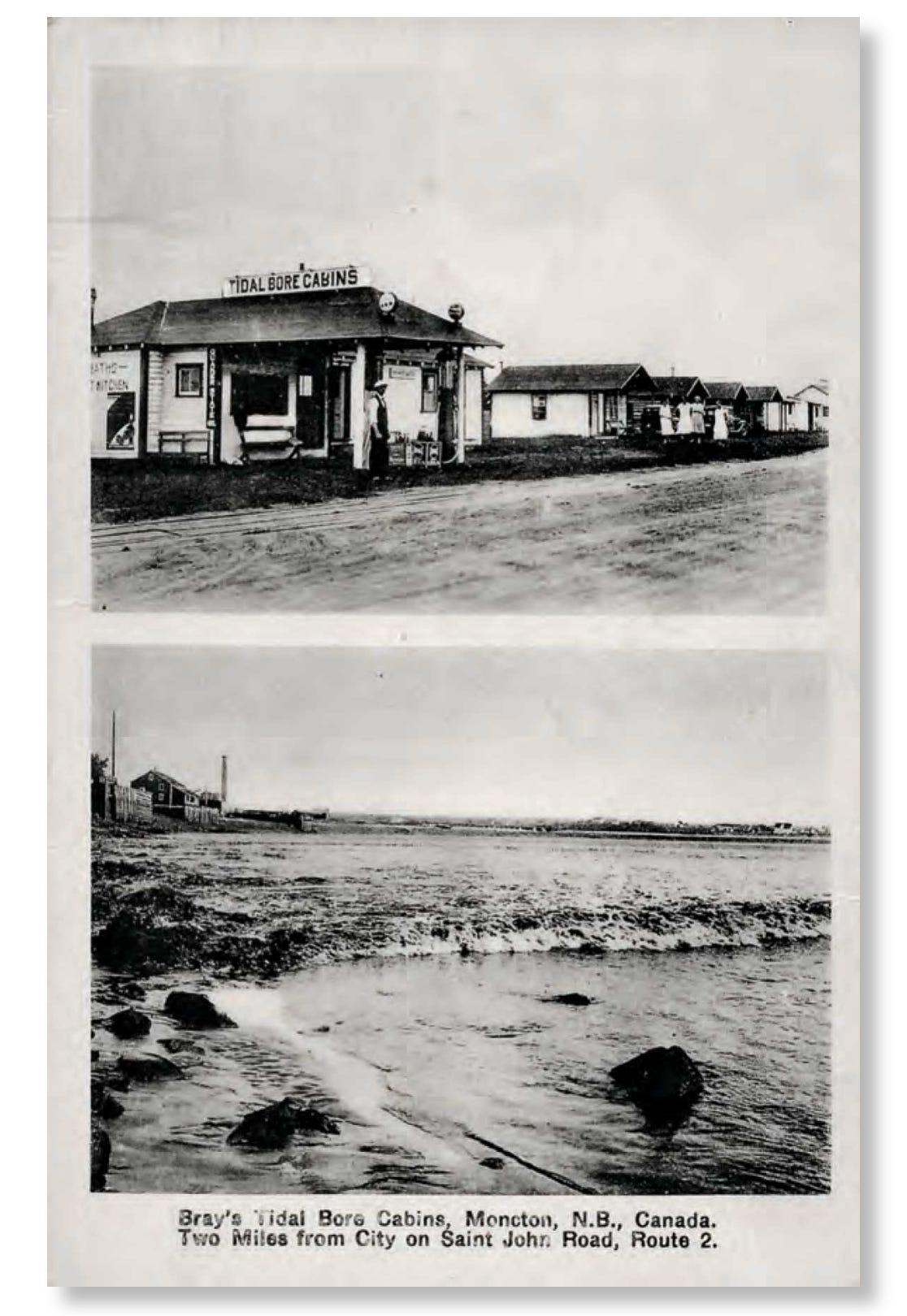
On the topic of natural wonders, visitors to New Brunswick would be remiss not to take in the nearby Bay of Fundy, which experiences the largest tidal variations in the world. The tidal bore on the Petitcodiac River in Moncton is created when the incoming tide pushes up against the river’s current. The result is a single broad wave that sweeps upstream, reaching heights of up to three feet.
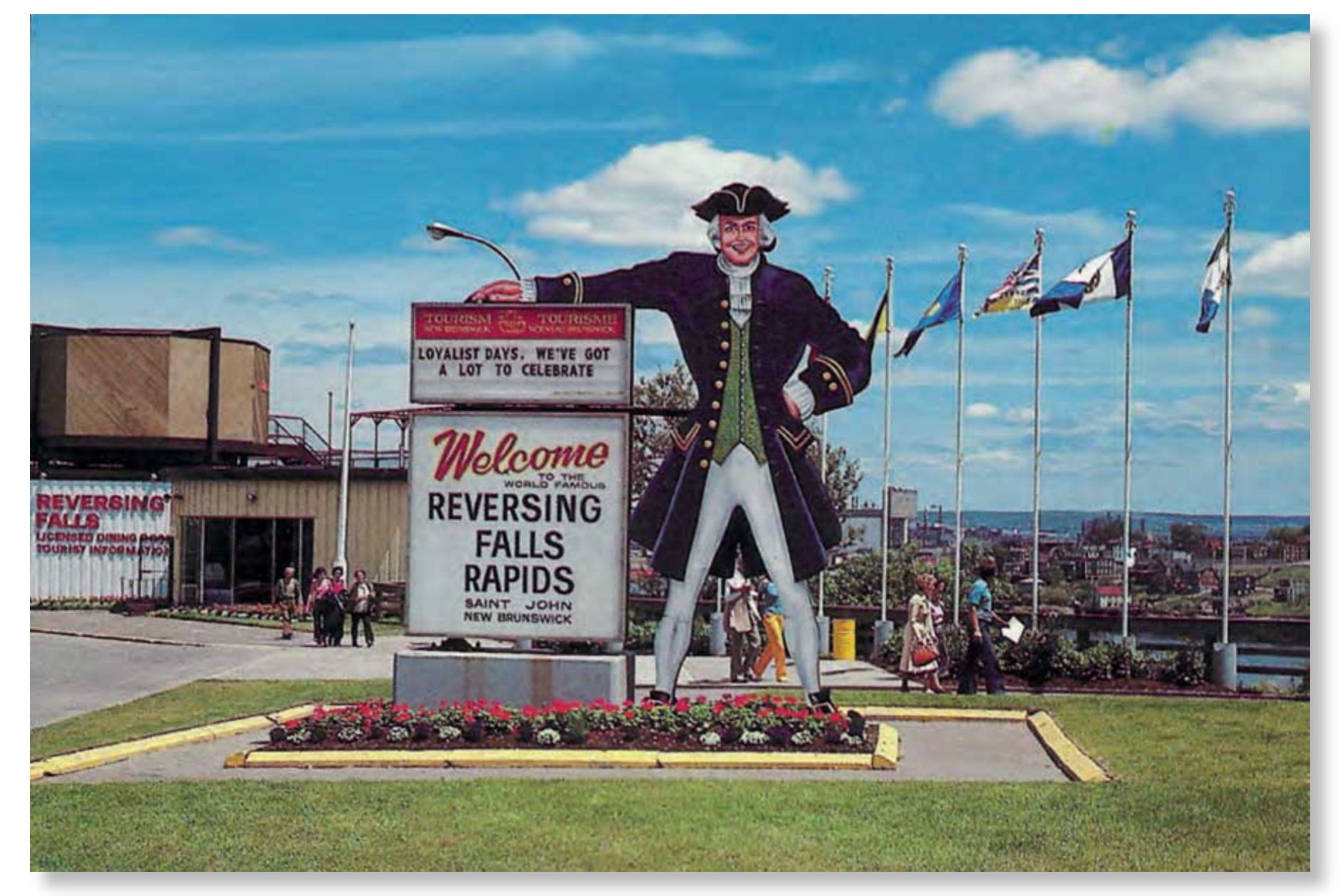
Similarly, the Reversing Falls Rapids on the Saint John River in Saint John are created when high tide collides in a rocky gorge section of the river over a submerged natural dam, reversing the flow and producing a series of whirlpools, waves, and white-water rapids. At low tide, the full flow of the river rolls and swirls through the narrow gorge (and over the same underwater dam) as it approaches the Bay of Fundy. In New Brunswick, both natural and roadside wonders abound!
This article originally appeared in the SCA Journal, Spring 2024, Vol. 42, No. 1. The SCA Journal is a semi-annual publication and a member benefit of the Society for Commercial Archeology.