
Vanishing Points: Phillips’ Postwar “New Look” Service Stations
By Cliff Leppke
At Phillips Petroleum, one mid-October day in 1958 would be remembered as the day “Boots saved the shield.” It was a typical corporate moment.
The proposal to change Phillips’ logo had come from the design and marketing firm of Lippencott & Margulies’ (L&M ) young account executive, G. William Anderson, Jr. Anderson hoped to sell Phillips a $100,000 design service that L&M called “corporate identity.” At the final presentation, everything seemed to be going well. Phillips Vice President of Sales, Ted Lyons, said he loved L&M’s new look for Phillips’ stations. However, company chairman Boots Adams had not yet seen the new trademark. When he did, he shouted his objection: “we’ll keep our present shield.”1
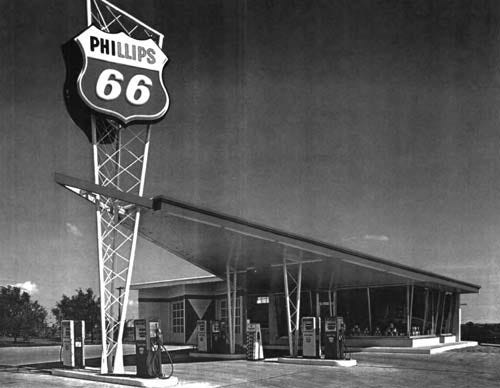
A swept wing station from the Bright New Designs brochure, early 1960s. See related video.
This seemingly small conflict over a corporate logo was more than a debate about marketing. It symbolized a much wider discussion about the role of design in postwar American life. The service station became a center of that debate. Thanks to Adams’ intervention, the shield would survive, but Phillips would adopt a new style for its stations. It is at that vanishing point – as old designs are replaced by new – that we can see Americans reinventing their representations of themselves.
The following examination explores the design of Phillips Petroleum’s postwar service stations as sites where American middle-class architects, marketing professionals, and consumers expressed their design ideas and social values. Phillips’ postwar stations were examples of the “New Look,” an abstract art influenced design aesthetic that became the zeitgeist of the 1950s. Other examples of the New Look included Christian Dior’s fashions, Jackson Pollock’s action paintings, and Herman Miller furniture. Phillips’ stations expressed the New Look through large aluminum-framed display windows, staggered rooflines, brick or stone veneer exteriors, and daring canopies that rose to a vanishing point….
The Origins of Phillips New Look
Phillips embarked upon an expansion program after World War II that sought economics-of-scale by marketing nation-wide. As with today’s convenience stores, they built stations to meet the imagined needs of motorists. Like most commercial architecture, the stations were examples of what designer Brook Stevens called, “planned obsolescence,” a form of continuous product development.2 They were periodically redesigned to stimulate consumer demand.
By the late 1950s, Phillips’ executives were expressing concern about the company’s dated look. In an effort to develop a new image that would improve brand recognition and symbolize the company’s shift from a family-run business to a modern corporation, Phillips tested new gas station ideas in the company’s headquarters town of Bartlesville, Oklahoma, and in Florida.3 Phillips had already grafted a flamboyant, V-shaped canopy onto a “New Look” service station in 1956 at a Ft. Lauderdale marina complex called Pier 66. For Phillips, this experimental station was an important step. A few years later, versions of the distinctive canopy would soar nationwide.
Phillips shift to the New Look occurred in three stages. First, during the early-1950s, it introduced rock-faced, large slanted-window stations known as Rock Frames.4
Second, in 1958 it sought the outside expertise of L&M to change its color schemes and general appearance, resulting in the painting of red, diamond-like symbols, on the stations.
Third, during the early 1960s the company introduced new stations, called Harlequins, which featured a modified Rock Frame floor plan and a pointed batwing canopy. When the cover of Phillips’ 1959 annual report announced “The New Look,” which encompassed the new station design, a new trademark, and revamped colors, these elements taken together amounted to a design revolution.
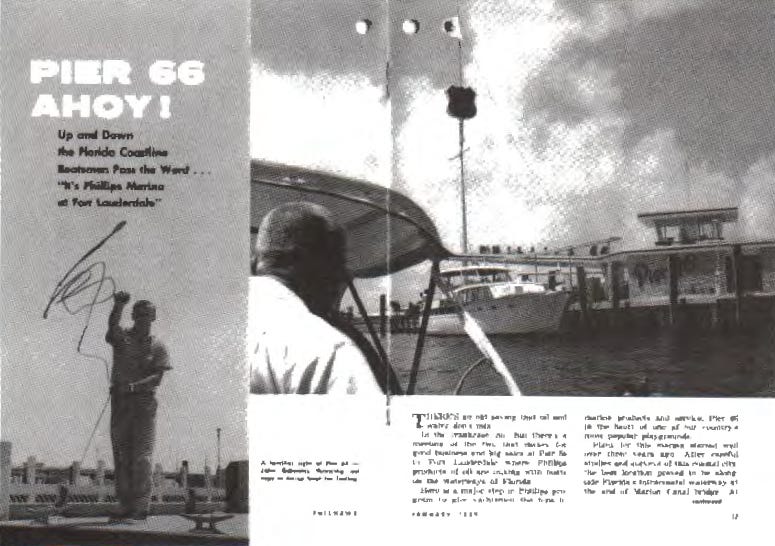
Pier 66 Marina, the first use of Phillips’ swept-wing design in 1956, at least four years before Phillips began building such “Harlequin” stations nationwide. It was pictured in the January 1959 Philnews. – Unless noted otherwise, all photos from author’s collection, used with permission of Phillips Corporate Archives.
Phillips search for an appropriate image for its service stations was dictated by what a 1957 Pure Oil ad called “America’s second automobile revolution.” Pure Oil said America’s proposed $100 billion network of freeways would create “strip cities” and shopping centers. The ad promised a “new breed of service station” suited to the new environment and assured consumers that “time and motion analysts” were working to meet their future needs.5
Executives at Phillips likewise saw the revolution coming and thought its new stations should portray the company in ways that would encourage investors to finance its expansion plan. The stations also needed to win lessee approval. Because the company-built stations and leased them back to dealers, it wanted a design that was attractive as well as inexpensive and simple to build.
The Harlequin butterfly canopy would come to be considered a key feature of the new station’s design. It was created by architect Clarence Reinhardt, who had begun his career as a Phillips draftsman in 1928. By the 1950s, Reinhardt, by then a project manager, was producing plans and specifications for most of Phillips’ buildings. Reinhardt was proud of his work on service stations; his resume claimed his most important job was constructing service stations on Oklahoma’s Turner Turnpike, which he completed in 1953, and constructing the up-to-date, airport-like Pier 66 Marina.6
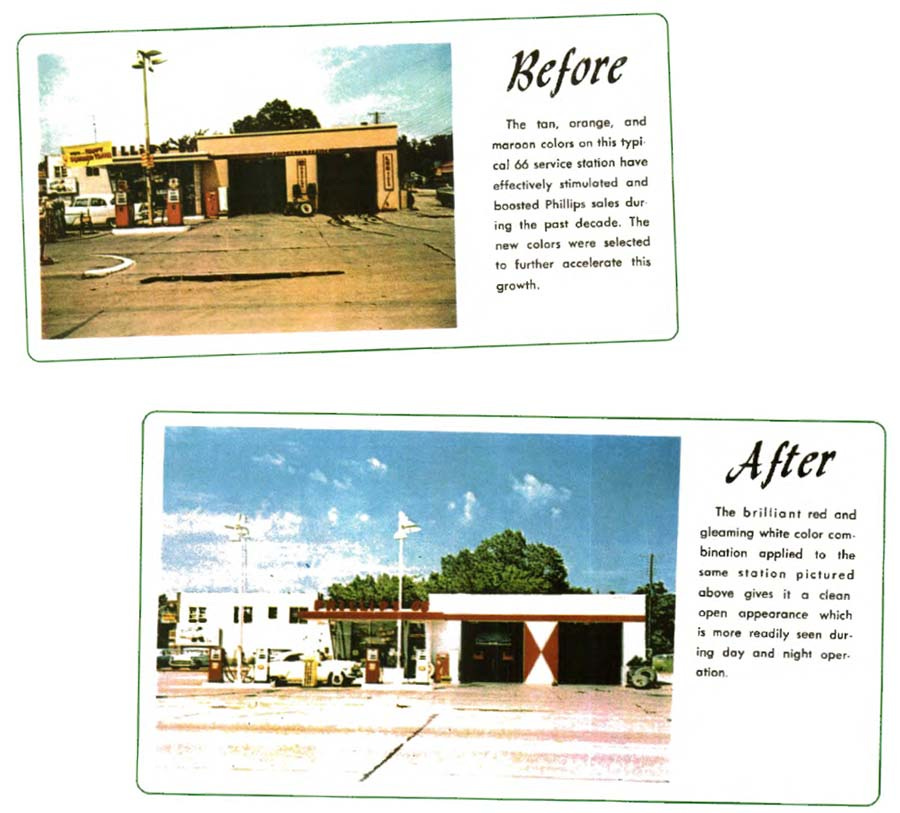
Before and after designs from a company brochure, September 1959.
Reinhardt’s peers in the architectural community similarly imagined the butterfly canopy and slanted windows as an expression of their architectural prowess. By the late 1950s, the canopy and slanted windows was de rigueur for any up-to-date commercial building. National Petroleum News said an Oklahoma City swept-wing Champlin station, created by the Los Angeles architectural firm Pereira and Luckman, “defines the station in the motorist’s mind with progress and the latest advances in engineering design.”7
Reinhardt’s use of the canopy had a more specific reference, however. Although the canopy was a widely circulated symbol of architectural playfulness, archival records indicate that Reinhardt was particularly inspired by early Los Angeles-area drive-ins, not by other swept-wing gas stations. In 1951, Phillips sent him on a fact-finding trip to Los Angeles to investigate new ways of boosting profits by integrating drive-ins and gas stations. Reinhardt’s report said an essential element of drive-in success was eye-popping architecture.
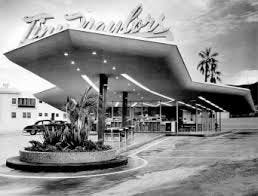
Tiny Naylors, one of the drive-ins studied by Clarence Reinhardt on his 1951 trip to California. – Phillips Corporate Archive
The first drive-in mentioned by Reinhardt was Tiny Naylors in Hollywood, a building which actor Humphrey Bogart had compared to “a huge bird about to take off.”8 Reinhardt’s new stations, which he designed after the trip, approached Naylors’ styling. The L&M’s redesign of the corporate sign also honored this aesthetic. Just months before Phillips started building Harlequin stations nationwide, it hired L&M to help with a $16 million makeover of its existing stations. Dealers paid to rent new signs and repaint their stations in a bold red-and-white color scheme that replaced the old tan, maroon, black, and orange colors. L&M was known for such total design packages that used abstract trademarks and bold color schemes. It had just launched an innovative service called “corporate identity,” directed by former Harvard Business School professor Mike Helfgott.9
When L&M studied Phillips’ existing stations, it found that consumers remembered the 66 best, the shield shape next, and the colors third. Consumers did not associate “cleanliness or superior quality products” with Phillips’ existing colors, nor did the old colors give a “feeling of bigness,” nor a “spacious ‘display’ look.”10 Because the old dark stations clashed with bright postwar suburban shopping centers, L&M’s major objective, according to account executive Anderson, was to “design a logo which could be internally lit for maximum impact.”11 It recommended replacing the old six-point shield trademark with a streamlined three-point modern version, the change that inspired Adams retort that “As long as I’m running the company, we’ll keep our present shield.”12 L&M did get the account, eventually and both the 66 and shield were kept, but their designs were simplified and the colors changed to red, white and black. Now they would “stand out” in the competitively “bright” suburbs.13
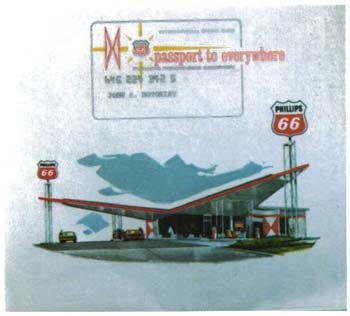
A mailer stub and real photo show the peaked-roof station at its peak, with two canopies. Above is Glendale, Wisc., in the same family since 1966. Photo from Phillips: the first 66 years, 1983.
Functions of The New Look
The New Look design was intended to add to “the instant recognition value of the color scheme.” The station would face the direction of heaviest traffic, lending a “distinctive look of action, busyness… a spacious, more appealing appearance.”14 According to Anderson, the new design helped “unify the many… architectural styles of the company’s filling stations.”15 The new design also had practical advantage. As Phillips tried to lure dealers from other companies, some of whom had their own stations, the new color scheme helped smooth the transition.16 Phillips’ brochures encouraged dealers to lease the new stations. The company tried to reassure dealers that the New Look would be profitable, too. One brochure stressed the station’s “customer appeal” and described the stations as looking “distinctive, neat and efficient… inviting and identifiable.”17 Each one offered “an eye-catching and pleasing composition from any vantage point.”18 The brochure also explained the meaning of the flamboyant canopy and the attention-getting eight-foot revolving illuminated sign mounted atop an open vertical pylon at the canopy’s peak: “The pointed shape and supporting pylon are distinctive designs, conveying to the motoring public that this is another advanced Phillips 66 station.”19 Another brochure described the exterior of stations as “changed to conform to propulsion age air flow design.”20 The glare-reducing slanted windows mimicked an airport control tower.
Phillips constantly suggested that the new design would be better for business. For example, the Bright New Designs brochure claimed the “value” of the popular slanted-bay ASV 203 model’s canopy “lies in its protection-providing feature, as well as its eye appeal and the additional lighting it provides.”21 Because it did not block the office, the canopy offered overhead protection for salesmen and clearance for larger vehicles. This station had a “vending wing” near the easy-to-clean interior rest rooms.
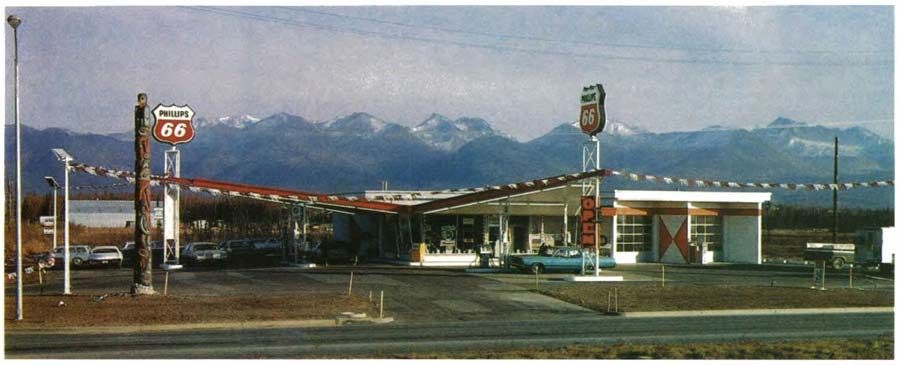
The company’s first station in Alaska, built 1967, which made Phillips the second company to market oil in all 50 states. – Owners collection.
A 1960 brochure for the early “S” series stations extolled the Harlequin’s efficiency; the large window area “permits salesmen when working in stalls to readily see customers at the island.” The slanted service stalls and the arrangement of the islands eliminated cross traffic and safety hazards.22 Phillips also stressed its improved lighting, recognizing that more motorists were driving at night. The Harlequin’s lights in the roof’s overhang, over stall entrances, and beneath the canopy “should contribute materially to additional night sales.”23 Phillips also thought that the canopy lighting, along with the station’s large windows and the bold colors, would invite more women to stop.
The features of typical 66 have Harlequin design represented a shift toward a style that historian Thomas Hine called “Populuxe,” a flamboyant decorative style employed from 1954-64 and employing pastel colors and futuristic contours to impart a sense of luxury to everyday objects.24
Advertising copywriters and art director s, who shared an aesthetic code with industrial designers, often promoted the Populuxe style. Phillips’ ad agency, Jay Walter Thompson, exploited the pointed canopy as a status symbol. Stylishly TV ads produced during 1962 advised motorists to “Go first-class.” One spot depicted a man who complemented his fine watch and tie clip with a Harlequin-design Phillips credit card. Another spot follows a smart-looking couple as they exit a swank hotel, in the rain, to a valet-supplied, luxurious Ford Thunderbird underneath the hotel’s canopy.25 Later, the T-Bird arrives at a Harlequin design station and parks underneath another canopy. This ad suggested that a Phillips station was more than a place to buy gas; it was an occasion for hedonism, and the station’s weather-beating Las Vegas-style canopy symbolized middle-class luxury.
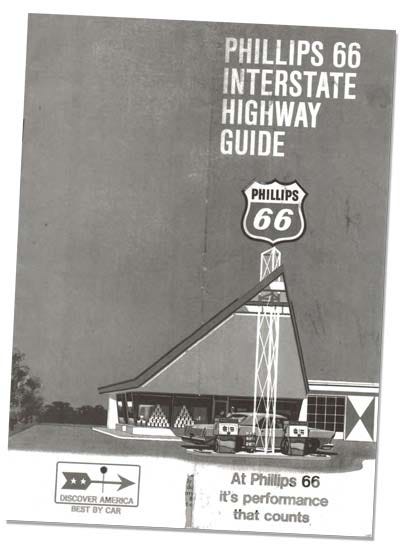
A swept wing station graces a 1968 company map.
The New Look Phillips station remained a symbol of luxury throughout the decade. A late-1960s ad humorously portrayed a Woody Allen-like young man on his first date. When he buys $1 of Flight Fuel for a night out, the attendant tells him that $1 will go a long way. Before the night is over, the couple arrives in of all places Las Vegas. After going “all-the-way” – to Las Vegas – the newlyweds return to the Phillips station to buy another $1 worth of high-octane aphrodisiac.26
End of the New Look
In 1968, Phillips began testing environmentally attuned ranch-style service stations.27 According to Phillips marketing engineer Cliff Sousa, “people’s attitudes about commercial architecture shifted.”28 The gas station became a symbol not of progress but of what was wrong in American life. John Kenneth Galbraith, writing in Life magazine, called the service station “the most repellent piece of architecture of the past two thousand years.” Though Galbraith was hyperbolic, criticism of this symbol of affluence became a sport. A 1968 Fortune article on gas station design argued that “of all the elements that make up the visual mess along U.S. roadsides, none is more unnecessarily ugly than the typical service station. Most of them are boxy structures that squat sadly behind unlovely pumps…. Bays yawn in the facade; banners flap wildly for attention; lurid, harshly lighted signs spell out trade names or bargains.”29
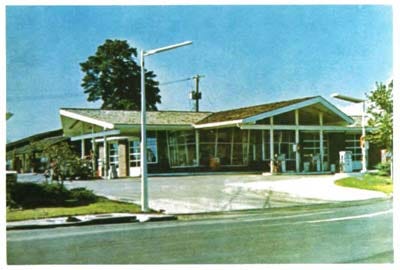
Environmentalism brought “top hatting” to stations, as seen in the company’s in-house Selling 66,; Spring 1971. The switch to ranch-style stations coincided with a restructuring of Phillips’ marketing and engineering departments.
Although the article described Phillips stations as “better than average prototypes,” some supporters of Lady Bird Johnson’s highway beautification movement did not agree. They championed domesticated blend-in, ranch-style stations, convincing many municipalities that such stations were better.30 “Blend-in” architecture offered a less garish displays of material culture. Companies also thought blend-in stations could take sales from other outlets. P.C. Thomas, Shell’s vice president of marketing said that his firm’s ranch-style stations had helped his company’s sales grow faster than industry averages.31
Other factors help explain why the swept-wing canopy, which originally lured consumers, began to drive them away. Mobile homes did not fit under the canopy’s 9.5-foot low end; Phillips had not forecast this “third automobile revolution.” Costs also played a role. Design features, such as the revolving 66 sign, proved expensive to ship and were replaced with square ones. As self-service replaced full-service, customers needed more protect ion from rain, snow, and sun than the pointed canopy provided.
All these factors, economic and aesthetic, forced Phillips to design a less garish station with a higher, less pointed canopy. Reinhardt opposed these changes. Sousa, who recommended scrap ping the Harlequin design altogether, believes Reinhardt effectively thwarted the marketing department’s plan to develop a new station. Sousa said Reinhardt told management “we can’t change that design.”32 However, when Phillips reorganized in 1969, the marketing department (rather than engineering) was made responsible for service station planning and design. Reinhardt retired the next year.
During the 1970s, Phillips downsized its retail operations and closed many Harlequin stations. The remaining outlets were altered through “tophatting,” a type of add-on exterior embellishment. Phillips advised dealers to install mansard roofs on New’ Look stations, to repaint them with dark earth-tone colors, and replace pointed canopies with flat ones. With these modifications, the Harlequin station lost its exuberant appearance. Today, original Harlequin stations are a scarce resource on the commercial landscape.
About the Author: Cliff Leppke, an American Studies Ph.D. candidate at St. Louis University, wrote a historic designation application that led Milwaukee to grant landmark status to a streamlined modern filling station.
Endnotes
[1] G. William Anderson, Jr., “How’Boots’ Saved the Shield,” a Dec. 6, 1991, letter in Phillips Archives, Bartlesville, Okla.
[2] Excerpts from Steven’s 1949 Minneapolis advertising convention address, which introduced the phrase “planned obsolescence,” found in Perry Lamek, “Designing the American Dream,” Milwaukee Magazine, August 1987, p. 52.
[3] Executive board minutes, May 15, 1958.
[4] The Sheer Look or Sheerform replaced the previous Streamlined Moderne, oblong-box style with a squared-off look.
[5] Saturday Evening Post, June 15, 1957, p. 16-17.
[6] Phillips Petroleum Archives has Reinhardt’s architectural license application.
[7] National Petroleum News, Nov. 1957. p. 134.
[8] Bogart quote found in Michael Karl Witzel, The American Drive-In, (Osceola, Wisc.: Motorbooks International, 1994) p. 119.
[9] “Phillips changes colors and trademark,” Selling 66, Sept-Oct., 1959, p. 5; Arthur Pulos, The American Design Adventure: 1940-1975, (Cambridge; MIT Press, 1988), discusses L&M’s postwar trademark design methods.
[10] Selling 66, p. 6.
[11] G. William Anderson Jr. on how the Phillips trademark was designed, in a letter he wrote Dec. 6, 1991, in the Phillips archives.
[12] Adams earned the “Boots” nickname because when he was a child he wore his boors in bed, from Anderson Jr. letter.
[13] Selling 66, p. 6.
[14] Ibid., p. 5.
[15] Anderson Jr. letter.
[16] Selling 66, p. 5.
[17] Phillips 66 “Bright New Designs Brochure,” early 1960s, p. I. IX Ibid., p. 8.
[18] Ibid., p. I.
[20] “The New ‘S’ Series Service Stations,” brochure circa 1960, p. 10. This brochure depicts rock-faced Harlequin stations.
[21] “Bright New Designs,” p. 8.
[22] Ibid.
[2]3 Ibid. p.9.
[24] Thomas Hine, Populuxe (New York: Knopf, 1986 ).
[25] JWT was Ford’s advertising agency.
[26] TV ads in Phillips Archives collection.
[27] “Friendly” meant attractively landscaped.
[28] Sousa says this in a “videotaped interview, which is part of the Phillips Archives collection.
[29] Fortune, Sept., 1968, p. 159.
[30] “Service: Stations: Big Changes Coming,” Petroleum Week, Nov. 11, 1960, p. 74, briefly discusses this.
[31] “Service Stations: The Needless Blot,” Fortune, Sept. 1966, p. 160.
[32] Sousa interview.
This article originally appeared in the SCA Journal, Spring 2005, Vol. 23, No. 1. The SCA Journal is a semi-annual publication and a member benefit of the Society for Commercial Archeology.